Which chimney to choose?

Which chimney to choose...

Types of chimneys

We offer a choice of several product groups: the ceramic chimney product group MK KOLEKT, the stainless steel chimney and stainless steel liners for existing chimneys product group MK KOLEKT Inox, and the flue system for condensing gas boilers product group MK KOLEKT Kondi. A brief comparison of each system is given below in Table 1.

Table 1.


 Ceramic chimneys – MK KOLEKTCondensing flues – AlmevaStainless steel chimneys and liners
ModelMK KOLEKTSTARRFLEXLIKSR-1SR-2SR-3
FUEL TYPECoal
Coal
Wood
Wood
Gas
Gas
Pellets
Pellets
Fuel: coal
–
Fuel: firewood
–
Condensing boiler
Gas
Fuel: pellets
–
Fuel: coal
–
Fuel: firewood
–
Condensing boiler
Gas
Fuel: pellets
–
Fuel: coal
–
Fuel: firewood
–
Condensing boiler
Gas
Fuel: pellets
–
Fuel: coal
Coal
Fuel: firewood
Wood
Condensing boiler
Gas
Fuel: pellets
Pellets
Fuel: coal
Coal
Fuel: firewood
Wood
Condensing boiler
Gas
Fuel: pellets
Pellets
Fuel: coal
Coal
Fuel: firewood
Wood
Condensing boiler
Gas
Fuel: pellets
Pellets
HEATING TECHNOLOGYStandard boiler
Standard
Condensing boiler
Condensing
Standard boiler
–
Condensing boiler
Condensing
Standard boiler
–
Condensing boiler
Condensing
Standard boiler
–
Condensing boiler
Condensing
Standard boiler
Standard
Condensing boiler
Condensing

Standard boiler
Standard
Condensing boiler
Condensing

Standard boiler
Standard
Condensing boiler
Condensing
PRESSUREOperation under positive pressure
–
Operation under negative pressure
Negative
Operation under positive pressure
Positive*
Operation under negative pressure Negative*
Operation under positive pressure
Positive*
Operation under negative pressure Negative*
Operation under positive pressure
Positive*
Operation under negative pressure Negative*
Operation under positive pressure
–
Operation under negative pressure
Negative
Operation under positive pressure
–
Operation under negative pressure
Negative
Operation under positive pressure
–
Operation under negative pressure
Negative
OTHER FEATURES<600°C
G50
Made in Germany GERMAN ceramics
<120°C
O20
Made in Switzerland Swiss components
<120°C
O20
Made in Switzerland Swiss components
<120°C
O20
Made in Switzerland Swiss components
<600°C
Ø100-300mm: G130
Ø350-450mm: G195
Ø550-600mm: G260
Made in Lithuania LITHUANIAN components
<600°C
G
Made in Lithuania LITHUANIAN components
<600°C
G
Made in Lithuania LITHUANIAN components

*The pressure mode of the Almeva chimney depends on the system diameter (≤Ø160 – negative; >Ø160 – positive).

Ceramic (modular) chimney system for all fuel types

Stainless steel flues, chimney liners and their components
Chimney height

The chimney must extend above the roof to a height that ensures continuous draught and does not create a fire hazard. Chimney height strongly affects how well the chimney draws. A chimney that is too low, combined with strong wind, can mean the flue does not have enough draught to fully remove combustion products. It is advisable to install the chimney as close to the roof ridge as possible.

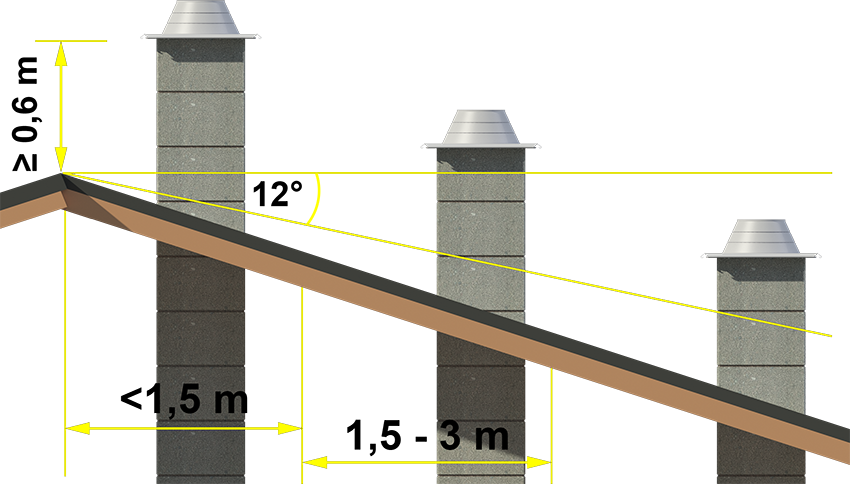
When the chimney is installed next to a building element that forms an obstacle, the chimney outlets must be installed as shown in illustration A. The chimney height above a flat roof, parapet or ridge must be at least 0.3 m if the surface is non-combustible, or 0.6 m if it is combustible. If the roof is flat or its pitch does not exceed 12°, regardless of the roof structure, the chimney outlets must be at least 0.6 m above the ridge or the edges of the building. If the chimney is built more than 1.5 m but less than 3 m from the ridge, the chimney must be no lower than the roof ridge. If the chimney is planned more than 3 m but less than 10 m from the ridge, the chimney must be no lower than an imaginary line drawn at an angle of 12 degrees from the horizontal.

Illustration A:
MK KOLEKT chimney height and distance from the roof angle diagram: dimensions and recommendations

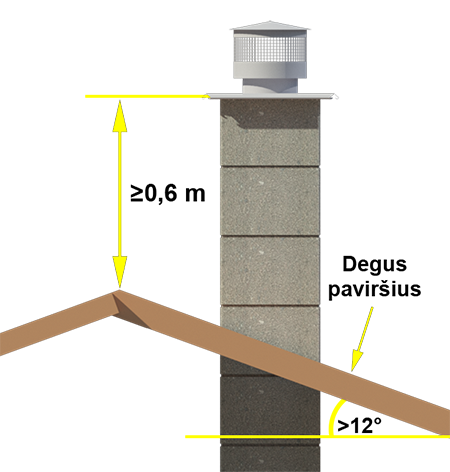
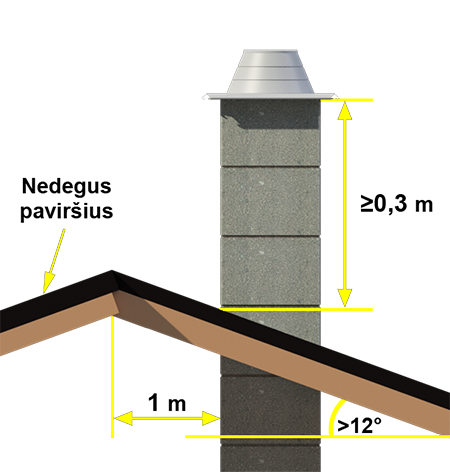
When the roof is steep, its pitch exceeds 12° and the roof covering is combustible, the chimney outlets must be at least 0.6 m above the ridge, as shown in illustration B. When the roof surface is combustible, remember to install a spark arrester as well, using metal mesh with openings no larger than 5x5 mm. When the roof is steep, its pitch exceeds 12° and the surface is non-combustible, the chimney outlets must be at least 0.3 m above the ridge and at least 1 m away from it, as shown in illustration C.

Illustration B:
MK KOLEKT chimney height diagram on a pitched roof with a protective chimney cap
Illustration C:
MK KOLEKT chimney height and distance from the roof line diagram: measuring instructions

FAQ

Frequently asked questions

What chimney diameter do I need?

The chimney diameter must be no smaller than the flue outlet diameter of the heating appliance and must meet the boiler manufacturer's requirements. Homes most often use Ø160, Ø180 and Ø200 mm chimneys, while higher-output and industrial appliances use Ø250 mm and more. If in doubt, send us your boiler details and we will help you choose.

Can a ceramic chimney be used with a gas boiler?

Yes. MK KOLEKT ceramic liners are resistant to acids and condensate, so the chimney is suitable for gas boilers as well as condensing boilers. For a condensing gas boiler, you can also choose the lighter Almeva plastic flue, designed for operation up to 120 °C.

Which chimney should I choose for wood, coal or pellets?

For solid fuel we recommend an MK KOLEKT ceramic chimney. The ceramic liners withstand temperatures from 60 to 600 °C, are resistant to soot fire and meet A1N1/B4N1 class requirements, and the chimney's fire resistance reaches 90 min.

How much does a chimney cost?

The price depends on the chimney height, liner diameter, number of ventilation ducts, type of connection tee and chimney top kit. Send an inquiry with these details or call +370 699 27 714, and we will prepare a quotation.

Can a liner be installed in an old masonry chimney?

Yes. To renovate an existing chimney, we offer round and oval MK KOLEKT Inox stainless steel liners. For a condensing boiler where the old chimney is not straight, the flexible Almeva FLEX flue is a good fit.

What documents come with the chimney?

The MK KOLEKT chimney system comes with a declaration of performance and installation instructions. The product is certified to EN 13063-1, EN 13063-2 and EN 13063-3, and the elements bear CE marking.

How long does chimney delivery take?

We deliver chimney kits throughout Lithuania within 1-3 working days.